Key Takeaways
- Approval Speed: Direct lenders can fund loans in 48 to 72 hours, whereas brokers typically require 5 to 10 business days to shop the market.
- Cost Structure: Brokers generally charge a 1% to 3% fee deducted from the loan proceeds, while direct lenders eliminate this middleman cost but may charge internal origination fees.
- Credit Flexibility: Brokers have access to a vast network of B-lenders and private syndicates, making them superior for applicants with credit scores below 650.
- Direct Communication: Working with a direct lender provides unfiltered access to the actual underwriters making the credit decisions.
- Market Access: Brokers can leverage their volume to negotiate lower interest rates or better prepayment privileges that individual borrowers cannot access on their own.
The 2026 Calgary Second Mortgage Landscape
Calgary’s secondary financing market reflects the city’s unique economic resilience and evolving real estate dynamics. The market has shifted significantly, influenced by energy sector stability, robust interprovincial migration, and increasingly strict federal lending regulations. Today’s borrowers face a complex landscape where traditional banks, credit unions, and alternative lending institutions aggressively compete for market share.
According to recent 2026 data from Statistics Canada, Calgary’s benchmark home price has maintained a steady upward trajectory, increasing average homeowner equity by 14% over the past three years. This substantial equity boom has triggered a surge in secondary financing applications. Homeowners are increasingly tapping into their property wealth to consolidate high-interest consumer debt, fund major renovations, or secure capital for entrepreneurial ventures.
However, the regulatory environment in Alberta provides a strict framework governing both intermediaries and financial institutions. The Real Estate Council of Alberta (RECA) mandates rigorous licensing requirements, ensuring robust consumer protection while fostering competitive market dynamics. Property values in various neighborhoods—from established communities like Mount Royal to rapidly expanding areas like Mahogany—present different Loan-to-Value (LTV) ratios and risk profiles that underwriters evaluate differently. Understanding how these entities assess geographic and financial risk is crucial for securing approval.
How Second Mortgage Brokers Operate in Calgary
Second mortgage brokers function as dedicated intermediaries between borrowers and a vast, diverse network of capital sources. They leverage their industry relationships and deep market knowledge to facilitate loan placements that a retail borrower could not access independently. These professionals maintain active licenses through provincial regulatory bodies and typically work with extensive networks that include Mortgage Investment Corporations (MICs), trust companies, and private syndicates.
The brokering process begins with a comprehensive assessment of the borrower’s financial situation, property appraisal details, and long-term wealth objectives. Experienced professionals use this data to identify institutions whose underwriting criteria perfectly align with the borrower’s unique profile. This matching process is invaluable in Calgary’s diverse market, where different institutions have varying appetites for specific property types or non-traditional income structures.
The Strategic Advantages of Using a Broker
- Unmatched Market Access: Brokers provide access to dozens of capital sources, including exclusive private syndicates that do not deal directly with the general public.
- Tailored Financial Solutions: They excel at structuring deals for complex files, such as securing stated income second mortgages for self-employed individuals who lack traditional T4 documentation.
- Enhanced Negotiation Power: By leveraging their high submission volumes, brokers can often negotiate lower interest rates, reduced penalty clauses, and superior prepayment privileges.
As David Chen, Principal Broker at Alberta Mortgage Solutions, explains: “The true value of an intermediary in 2026 isn’t just finding a lower advertised rate; it’s structuring the entire deal to minimize total borrowing costs over the term, especially for clients requiring alternative income verification.”

Direct Lender Operations and Benefits
Direct lenders in Calgary operate their own proprietary lending programs. They make credit decisions internally, fund the loan entirely from their own capital reserves, and service the account throughout its lifecycle. This direct-to-consumer relationship model offers several distinct advantages, particularly for borrowers who highly value speed, transparency, and clear accountability.
The operational efficiency of direct lending translates to significantly faster processing times. When borrowers work directly with the source of capital, they eliminate the coordination steps and communication lags inherent in intermediary relationships. This rapid execution is crucial for borrowers facing time-sensitive financial opportunities, such as needing to fund a down payment on a commercial investment property before a strict closing deadline.
When to Choose a Direct Lender
- Speed and Efficiency: Internal underwriting allows for comprehensive approvals and funding in as little as 48 to 72 hours.
- Zero Intermediary Fees: Borrowers save the typical 1% to 3% commission charged by brokers, preserving more of their home equity.
- Direct Communication: Clients enjoy unfiltered access to the actual decision-makers and underwriters handling their file, reducing misunderstandings.
Furthermore, these institutions provide ongoing relationship continuity. When borrowers need to modify loan terms, request payment deferrals, or discuss renewal options, they work directly with the entity that holds their registered charge. The Financial Consumer Agency of Canada (FCAC) notes that direct communication with a primary financial institution can often lead to faster, more favorable resolutions during periods of unexpected financial hardship.
Head-to-Head Comparison: Brokers vs. Direct Lenders
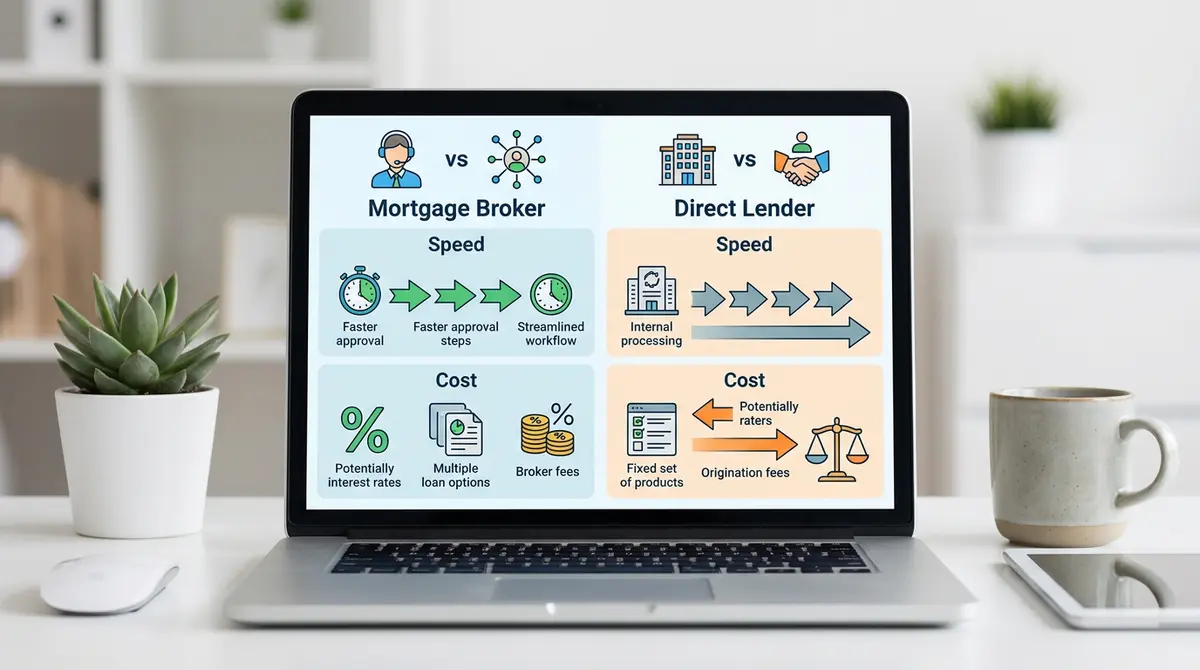
To make a mathematically sound decision, homeowners must evaluate how these two options stack up across critical lending metrics. The table below outlines the primary operational differences in the 2026 Alberta market.
| Feature | Second Mortgage Brokers | Direct Lenders |
|---|---|---|
| Approval Speed | Moderate (5-10 business days) | Fast (2-5 business days) |
| Lender Access | High (Multiple institutions & private) | Low (Only their proprietary products) |
| Upfront Fees | Broker fees (1% – 3% of loan amount) | No broker fees (Origination fees may apply) |
| Approval Odds | High (Can shop difficult or bruised files) | Moderate (Must meet strict internal criteria) |
| Communication | Through the broker (Intermediary) | Direct to the internal underwriter |
This comparison highlights why the debate is rarely one-size-fits-all. A borrower with a pristine credit score of 800 and stable employment might prefer the fee-free speed of a direct institution, while a self-employed contractor with a 620 credit score will likely require a broker’s extensive network to secure approval.
Cost Analysis: Understanding Fee Structures
Understanding the complete cost structure of secondary financing requires careful analysis of both obvious and hidden fees. The total cost of borrowing extends far beyond the advertised interest rate. It includes origination fees, appraisal costs, legal disbursements, and ongoing servicing charges that significantly impact your Annual Percentage Rate (APR).
Broker fee structures in Calgary vary considerably based on the complexity of the file. Borrower-paid fees typically range from 1.5% to 3.0% of the total loan amount. For a $100,000 equity loan, this means $1,500 to $3,000 in upfront costs are deducted directly from your loan proceeds at closing. While direct institutions generally do not charge these intermediary commissions, they may implement their own processing or administrative costs.
It is also vital to understand how compounding frequency silently increases your debt over the life of the loan. A lower nominal rate compounded monthly can sometimes cost more than a slightly higher rate compounded semi-annually.
As Sarah Jenkins, Senior Underwriter at Prairie Financial, states: “Borrowers often fixate solely on the interest rate. However, a direct lender offering 9.5% with zero fees is mathematically superior to a broker offering 9.0% with a 3% upfront fee on a standard one-year term. You must calculate the true APR.”
Step-by-Step: Choosing the Right Lending Path
Navigating the equity extraction process requires a systematic, data-driven approach. Follow these essential steps to determine which lending path best suits your 2026 financial goals:
- Calculate Your Available Equity: Determine your home’s current market value through a professional appraisal and subtract your primary mortgage balance. Most institutions in Alberta allow you to borrow up to 80% of your home’s appraised value.
- Assess Your Credit Profile: Pull your comprehensive credit report from Equifax or TransUnion. If your score is above 680 with stable T4 income, a direct lender is highly viable. If your score is below 650, an intermediary is recommended.
- Gather Documentation: Prepare your Notices of Assessment (NOAs), recent pay stubs, property tax statements, and existing mortgage details. Properly organizing your mortgage paperwork can accelerate approval times by days.
- Define Your Timeline: If you need funds in less than a week to capitalize on an investment or prevent a default, direct private capital is your best option. If you have a month to shop around, engage a broker to find the lowest possible rate.
Edge Cases and Specialized Scenarios
Certain life events and complex financial situations dictate which lending route is optimal. For instance, homeowners going through a marital separation often face complex debt restructuring. When navigating a spousal buyout, brokers are usually preferred because they can find specialized institutions willing to use projected post-divorce income and child support payments in their debt service calculations.
Conversely, if you are facing imminent legal action from your primary bank, speed becomes your only priority. Understanding the final order of foreclosure timeline means you cannot afford to wait weeks for an intermediary to shop your file. In these high-stress scenarios, approaching an asset-based direct private lender ensures you secure the funds necessary to halt the legal process immediately.
Self-employed individuals also face unique hurdles. Verifying self-employed mortgage income often requires the “reasonability test” rather than standard tax returns. Brokers excel in this niche, as they know exactly which alternative lenders accept bank statements and business contracts in lieu of traditional NOAs.
Finally, borrowers must weigh their options against other financial products. Before committing to either path, it is prudent to spend time comparing a second mortgage to a cash-out refinance. With the Bank of Canada adjusting overnight lending rates throughout 2026, breaking your first mortgage might trigger prohibitive Interest Rate Differential (IRD) penalty fees, making secondary financing the mathematically sound choice.

Conclusion
Ultimately, the choice between utilizing a broker or a direct lender in Calgary comes down to your unique financial footprint. Strong credit, verifiable income, and a need for speed align perfectly with direct lenders. Conversely, complex income structures, bruised credit, and the desire to compare multiple institutional offers require a broker’s extensive network.
By understanding the operational differences, fee structures, and market advantages of each approach, you can confidently secure the capital you need while protecting your most valuable asset. If you are ready to explore your equity options in the 2026 market, contact our team today for a confidential assessment of your property’s borrowing potential.
Frequently Asked Questions (FAQ)
Do second mortgage brokers charge upfront fees in Calgary?
Yes, most brokers charge a professional fee ranging from 1% to 3% of the total loan amount. However, this fee is typically deducted directly from the loan proceeds at closing by the real estate lawyer, rather than paid out of pocket beforehand.
Are direct lenders cheaper than mortgage brokers?
Direct lenders can be cheaper because they eliminate the middleman’s commission. However, brokers can sometimes negotiate lower interest rates that offset their fees, making it essential to compare the total Annual Percentage Rate (APR) of both options.
Can a broker help me if I have bad credit?
Absolutely. Mortgage brokers specialize in matching borrowers with bad credit to alternative and private institutions that focus primarily on home equity rather than credit scores. They have access to B-lenders that traditional banks do not offer.
How fast can a direct lender fund a second mortgage?
Because direct lenders underwrite and fund their own loans internally using proprietary capital, they can often process, approve, and fund a loan in as little as 3 to 5 business days, provided all appraisal and income documentation is in order.
Is it safer to use a direct lender or a broker?
Both options are highly safe and strictly regulated in Alberta. Brokers and direct lending institutions must adhere to the rigorous licensing, disclosure, and consumer protection standards enforced by the Real Estate Council of Alberta (RECA).
Will applying with multiple direct lenders hurt my credit score?
Yes, each direct application results in a hard credit inquiry, which can temporarily lower your Equifax or TransUnion score. A broker, however, pulls your credit once and uses that single report to shop your file to multiple institutions, protecting your credit rating.