Discharging a second mortgage in Alberta is the formal legal process of removing a lender’s financial claim, or lien, from your property’s title at the provincial Land Titles Office after the loan is fully repaid. Simply making your final payment does not automatically clear your title. Without executing and registering a specific Discharge of Mortgage document, the lender retains a registered interest in the property, legally preventing you from selling, transferring ownership, or refinancing the home. To regain unrestricted ownership rights, homeowners must proactively coordinate with their financial institution to submit the required statutory forms to provincial authorities.
Key Takeaways
- Final payment does not equal clear title: A zero balance on your loan statement does not automatically remove the legal encumbrance from your property.
- Mandatory provincial documentation: You must file a formal Discharge of Mortgage or Encumbrance form with the Alberta Land Titles Office.
- Processing timelines: In 2026, standard registry processing takes between 10 to 15 business days, depending on submission volumes.
- Professional verification is required: Signatures on discharge documents typically require authentication by a Commissioner of Oaths or a Notary Public.
- Unrestricted ownership: Successfully registering the discharge is the only way to restore your absolute legal right to sell or refinance the property.
Understanding the Mechanics of Title Clearance in Alberta
When you initially secure secondary financing, the lender registers a legal claim against your property. This claim, known as a lien or encumbrance, acts as security for the debt. It ensures that if you default, the lender has a legal avenue to recover their funds. However, the system is not automated in reverse. When you satisfy the debt, the provincial registry does not receive an automatic notification from your bank.
According to the Real Estate Council of Alberta (RECA), the responsibility to ensure the title is cleared falls squarely on the homeowner and their legal representatives. The lender is obligated to provide the discharge document, but the actual registration process requires deliberate action.
As Marcus Thorne, a senior real estate attorney in Edmonton, explains: “Homeowners frequently confuse their final payment receipt with title clearance. A zero balance is a financial milestone, but the discharge is a legal necessity. Until that instrument is registered, your property remains legally encumbered.”
The Legal Impact on Your Property Rights
Leaving an inactive lien on your property title creates significant legal and financial bottlenecks. Data from the Alberta Land Titles Office in early 2026 indicates that approximately 28% of property transactions face unexpected delays due to uncleared secondary liens that were paid off years prior.
If you attempt to sell your home, the buyer’s lawyer will pull a historical title search. Any active encumbrance will halt the transaction until it is resolved, potentially causing the buyer’s financing to expire. Similarly, if you wish to explore cash-out refinancing options, the new lender will refuse to fund the loan until they can secure their desired priority position on the title.
Proactively clearing your property title ensures your hard-earned equity translates into unambiguous, unrestricted legal rights.
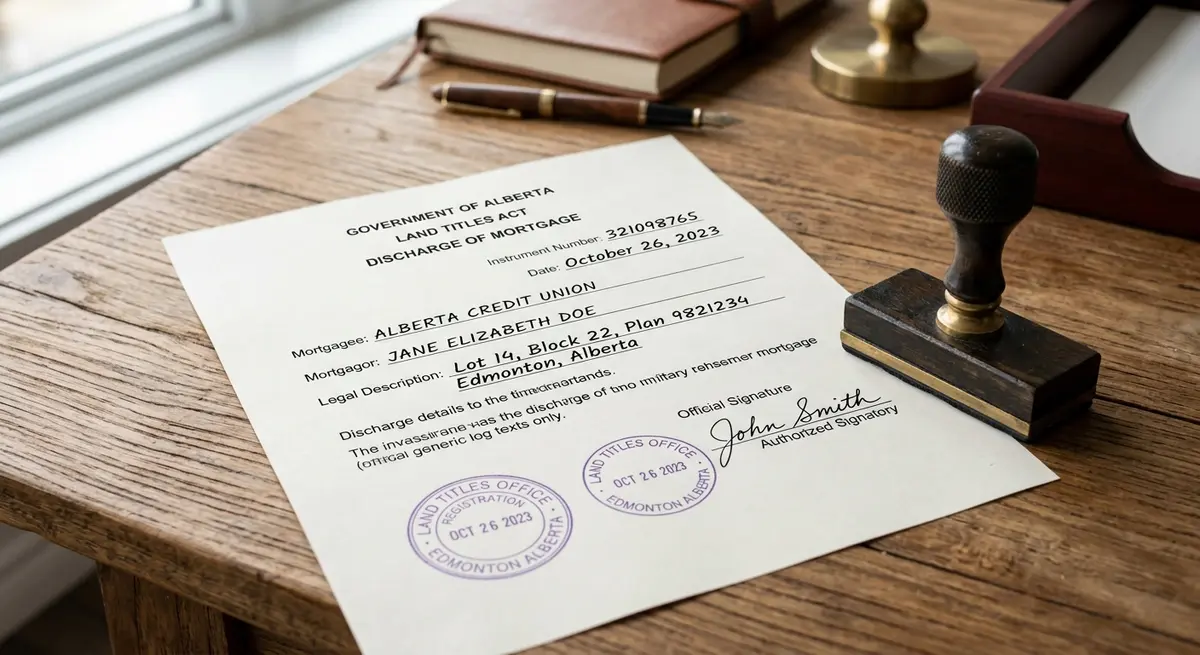
Step-by-Step: The 2026 Alberta Mortgage Discharge Process
Navigating the provincial registry system requires precision. Missing a single signature or submitting an outdated form will result in immediate rejection by the registry examiners. Follow these exact steps to ensure a smooth transaction.
Step 1: Request a Formal Payout Statement
Before making your final payment, request a binding payout statement from your lender. This document calculates the exact amount owed on a specific date, accounting for daily interest and any discharge administration fees. Paying the balance shown on your monthly statement is often insufficient due to accrued per diem interest.
Step 2: Settle the Balance and Request the Discharge Form
Once the exact payout amount is transferred and cleared, submit a formal written request to your lender to prepare the Discharge of Mortgage document. Under Alberta law, lenders must provide this document within a reasonable timeframe, typically 7 to 10 business days.
Step 3: Document Execution and Notarization
The lender will sign the discharge form. In Alberta, corporate seals or specific Affidavits of Execution are required. The signatures must be witnessed and authenticated by a Commissioner of Oaths or a Notary Public to verify the identity of the signing authorities.
Step 4: Submission to the Land Titles Office
The fully executed document must be submitted to the Alberta Land Titles Office (ALTO). This can be done via mail, in person at the Edmonton or Calgary offices, or electronically through the SPIN2 (Spatial Information System) portal by a registered legal professional.
Essential Documents Required for Title Clearance
Provincial systems demand precise paperwork. Every document serves a specific purpose in proving your financial obligations are fulfilled. Retaining your mortgage documents throughout the life of the loan makes this final step significantly easier.
- Form DSC (Discharge of Mortgage or Encumbrance): The official provincial form that legally releases the lender’s interest.
- Affidavit of Execution: A sworn statement by the witness to the lender’s signature, confirming the document was signed voluntarily.
- Current Certificate of Title: A recent pull of your property title to verify the exact instrument number of the mortgage being discharged.
- Lender’s Confirmation Letter: A formal letter on company letterhead stating the debt has been satisfied in full.
Comparison: DIY vs. Legal Professional Discharge
| Feature | DIY Submission | Legal Professional |
|---|---|---|
| Cost | Low (Only registry fees) | Moderate ($150 – $400) |
| Processing Speed | Standard (10-15 days) | Expedited via SPIN2 portal |
| Error Risk | High (Form rejections common) | Minimal (Guaranteed accuracy) |
| Convenience | Requires mailing or in-person visits | Fully hands-off for the homeowner |
Costs and Fees Associated with Discharging a Lien
What financial considerations come into play when finalizing your property’s legal status? Multiple costs emerge during this phase. In 2026, the Bank of Canada notes that administrative fees across financial institutions have standardized, but variations still exist based on your specific lender type.
First, expect a Lender Discharge Fee. Most financial institutions charge between $250 and $400 to prepare the legal paperwork. This covers the administrative cost of having their signing officers execute the documents and notarize them.
Second, there are Provincial Registry Fees. The Alberta Land Titles Office charges a flat statutory fee to register the discharge. As of 2026, this fee is highly affordable, typically under $50 per instrument being removed. However, if you are removing legal claims from your title that involve multiple encumbrances, each instrument incurs its own fee.
Finally, if you hire a lawyer or notary, you will incur Legal Service Fees. While optional for a simple discharge, legal professionals ensure the document is flawless. If you are implementing principal reduction strategies that lead to an early payoff, always check your contract for prepayment penalties, which can significantly outweigh the standard discharge fees.

Common Scenarios Triggering a Discharge
Homeowners generally encounter the discharge process during three specific life events. Each scenario demands a slightly different approach to timing and coordination.
1. Natural Loan Maturity
You have made your final scheduled payment at the end of your amortization period. In this scenario, there is no rush. You simply request the discharge documents, pay the administrative fee, and file the paperwork at your convenience. However, it is highly recommended not to delay, as tracking down lenders years later if they merge or rebrand can be a logistical nightmare.
2. Property Sale
When selling your home, the discharge process is handled entirely by your real estate lawyer. The buyer’s funds are held in trust. Your lawyer uses those funds to pay off your outstanding mortgage balance, obtains the discharge from the lender, and registers it with the province to provide the buyer with a clear title. This all happens simultaneously on the closing date.
3. Refinancing with a New Lender
If you are switching lenders to secure a better rate, the new lender requires the old lien to be removed so they can take the primary or secondary position on the title. Your lawyer will facilitate an “undertaking”—a legal promise to the new lender that the old mortgage will be discharged as soon as the payout funds are processed.
Navigating the Alberta Land Titles Office (ALTO)
The Alberta Land Titles system operates under the Torrens System of land registration, which guarantees the accuracy of the title. Because the government guarantees this accuracy, their examiners are incredibly strict about document formatting.
According to the Law Society of Alberta, the most common reason for a discharge rejection is a mismatch between the lender’s name on the original mortgage document and the name on the discharge form. For example, if your lender was “ABC Mortgages Inc.” but the discharge says “ABC Mortgages Ltd.”, the registry will reject it.
Processing times fluctuate. During the spring real estate boom, standard mail-in discharges can take up to 15 business days. Legal professionals using the digital SPIN2 system can often see updates reflected on the title within 48 to 72 hours.

Why Professional Assistance Matters
While the provincial government allows citizens to file their own discharge paperwork, the margin for error is high. A rejected form means starting the process over, paying new registry fees, and potentially delaying a sale or refinance.
Legal professionals and specialized mortgage brokers add immense value by organizing your mortgage paperwork and communicating directly with the lender’s payout department. They know exactly who to contact to expedite delayed documents and have the authority to submit forms electronically.
Furthermore, if your lender has gone out of business or cannot be located—a rare but stressful occurrence—a lawyer can help you apply for a court order to discharge the mortgage under the Alberta Law of Property Act.
Conclusion
Successfully removing a financial claim from your home’s title marks the true final step in your borrowing journey. Accurate documentation, prompt payment of administrative fees, and strict adherence to the Alberta Land Titles Office requirements are non-negotiable for updating your property records. Timely action prevents severe delays when you eventually decide to sell or refinance your residence.
Partnering with knowledgeable experts helps you navigate form submissions, notarizations, and registry communications efficiently. Clear titles provide absolute peace of mind and full control over your hard-earned equity. If you need assistance navigating the complexities of property titles or securing new financing, contact us today for expert guidance tailored to your specific situation.
Frequently Asked Questions
What exactly does discharging a mortgage mean?
Discharging a mortgage is the formal legal procedure of removing a lender’s registered financial claim (lien) from your property’s title. This process updates the provincial land registry records to definitively prove that the debt is settled and the lender no longer has any rights to the property.
How long does the discharge process take in Alberta?
In 2026, once the lender provides the signed discharge document, the Alberta Land Titles Office typically takes 10 to 15 business days to process standard submissions. If submitted electronically by a legal professional, the title can often be updated within 48 to 72 hours.
Do I have to pay a fee to clear my title?
Yes, there are usually two fees involved. Your lender will charge an administrative fee (typically $250 to $400) to prepare and notarize the legal release document, and the provincial registry charges a small statutory fee (under $50) to process the update.
Can I sell my house if the mortgage isn’t discharged yet?
You can list and sell the house, but the transaction cannot legally close until the title is cleared. Your real estate lawyer will use the proceeds from the sale to pay off the remaining balance and facilitate the discharge simultaneously on the closing date.
What happens if I lose my discharge document before registering it?
If you lose the original signed Discharge of Mortgage form before submitting it to the Land Titles Office, you must contact your lender to request a replacement. The lender will likely charge a secondary administrative fee to draft, sign, and notarize a new document.
Does a zero balance on my credit report mean my title is clear?
No. Credit bureaus track your financial repayment history, while the Land Titles Office tracks legal ownership and property claims. You can have a zero balance on your credit report while the legal lien remains fully active on your property title.