When an MCAP mortgage falls into arrears in Calgary, the lender initiates a structured legal process that can culminate in foreclosure — but homeowners retain significant rights and options at every stage. Alberta’s foreclosure system operates under the Law of Property Act, and MCAP, as a monoline lender specializing in residential mortgages, follows a predictable enforcement pattern. The moment you miss a payment, a clock starts ticking, yet with swift, informed action, you can halt the process, negotiate a remedy, or exit the property on your own terms while preserving equity.
Key Takeaways
- MCAP issues a formal demand letter after 15 days of missed payment, triggering a legally defined redemption period.
- Alberta homeowners have a redemption period to pay all arrears and legal costs in full, stopping the foreclosure entirely.
- Filing a Statement of Defence in the Court of King’s Bench can extend your time in the home by several months.
- A Judicial Sale is the most common outcome; it allows you to retain surplus equity after the mortgage and costs are paid.
- Private refinancing, equity-based lending, and negotiated forbearance agreements are all viable alternatives to losing your home.
- Calgary’s unique economic cycles — particularly in the energy sector — mean MCAP often works with borrowers who can demonstrate a return to income stability.
- Acting before the Final Order of Foreclosure is critical; after that point, your right to redeem the property is extinguished.
Understanding MCAP’s Role in the Calgary Mortgage Market
MCAP Financial Corporation is one of Canada’s largest independent mortgage finance companies, originating and servicing residential mortgages across the country. Unlike the big six banks, MCAP operates primarily through mortgage brokers and does not hold retail deposits. This distinction matters because MCAP’s arrears management approach is often more rigid in its timelines but more flexible in its loss mitigation options. According to the Canada Mortgage and Housing Corporation (CMHC), monoline lenders like MCAP held approximately 18% of outstanding residential mortgage debt in Canada as of early 2026, a figure that has grown steadily over the past decade.
In Calgary, MCAP’s portfolio is heavily concentrated in single-family detached homes and condominiums purchased during the 2021–2024 market peak. This concentration means that when property values fluctuate — as they have in Calgary’s energy-dependent economy — borrowers can find themselves in negative equity or struggling to refinance. MCAP’s underwriting standards are generally conservative, but economic shocks such as oil price collapses or prolonged unemployment can push even well-qualified borrowers into arrears.
The MCAP Arrears Timeline: From Missed Payment to Foreclosure
The path from a first missed payment to a foreclosure sale follows a legally mandated sequence in Alberta. Understanding this timeline is the single most powerful tool a homeowner has, because each stage presents a distinct opportunity to intervene.
Stage 1: Default and Demand Letter (Days 1–30)
When you miss a mortgage payment with MCAP, the lender’s internal collections department begins contacting you — typically by phone and email — within 5 business days. After 15 days of non-payment, MCAP issues a formal Notice of Default under Section 41 of the Law of Property Act. This document is not a court filing; it is a contractual demand that outlines the total arrears, including any late fees and administrative charges. At this stage, you can cure the default simply by paying the outstanding amount. No legal proceedings have commenced, and your credit report may not yet reflect the delinquency if you act within 30 days.
Stage 2: Statement of Claim Filed (Days 30–90)
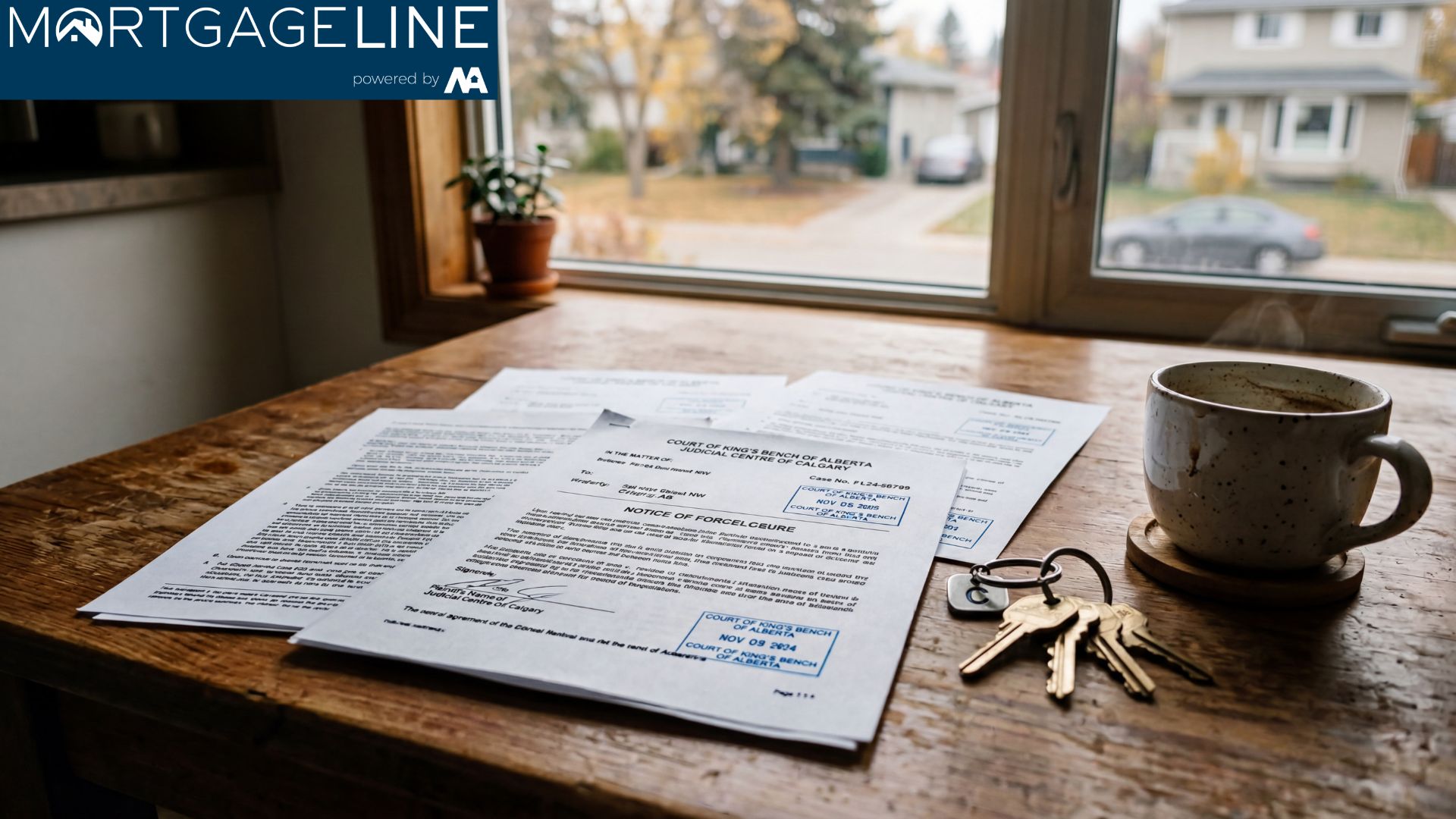
If the arrears remain unpaid after the demand letter period expires, MCAP instructs its Calgary-based legal counsel — typically a firm specializing in foreclosure law — to file a Statement of Claim in the Alberta Court of King’s Bench. This is the official commencement of foreclosure proceedings. You will be served with the Statement of Claim personally or by registered mail. The document names you as the defendant and sets out the amount claimed, which includes the principal balance, accrued interest, legal fees, and disbursements.
Once served, you have 15 days to file a Statement of Defence if you wish to contest the action, or 30 days if you are served outside Alberta. Filing a defence does not mean you deny the debt; it can simply request that the court grant additional time to sell the property privately or arrange alternative financing. As Sarah Thompson, a Calgary-based real estate lawyer with 18 years of foreclosure defence experience, explains: “A well-drafted Statement of Defence can buy a homeowner 90 to 120 additional days in the property. That time is invaluable for negotiating with MCAP or arranging a private sale.”
Stage 3: Redemption Period and Order Nisi (Months 3–6)
After the Statement of Claim is filed and the defence period expires, MCAP applies to the court for an Order Nisi. This order formally establishes the amount owing and sets the redemption period — the time you have to pay the full amount and stop the foreclosure. In Alberta, the standard redemption period for residential properties is six months from the date of the Order Nisi, though the court can shorten or extend this period based on the circumstances.
During the redemption period, you remain in possession of the property. You can sell it privately, refinance with another lender, or pay the arrears in full. The redemption amount includes the entire mortgage balance, not just the missed payments. This is a critical distinction: you cannot simply “catch up” on payments once the Order Nisi is granted; you must pay the entire debt.
Stage 4: Application for Final Order of Foreclosure (Months 6–9)
If the redemption period expires without payment, MCAP applies for a Final Order of Foreclosure. This order transfers title of the property to MCAP, extinguishing your equity and right of redemption. Once granted, the property belongs to the lender absolutely. However, in practice, MCAP — like most institutional lenders — typically pursues a Judicial Sale rather than a strict foreclosure. In a Judicial Sale, the court oversees the sale of the property, and any surplus proceeds after paying the mortgage, legal costs, and real estate commissions are returned to you.
According to data from the Government of Alberta, approximately 72% of residential foreclosure actions in Calgary result in a Judicial Sale rather than a Final Order vesting title with the lender. This statistic underscores the importance of maintaining the property’s condition and cooperating with the listing process to maximize sale proceeds.
Calgary-Specific Factors That Influence MCAP Foreclosures
Calgary’s housing market and economic landscape create unique dynamics in MCAP foreclosure cases. The city’s reliance on the energy sector means that employment disruptions are often cyclical rather than permanent. MCAP’s loss mitigation teams are familiar with this pattern and may be more willing to offer forbearance agreements to borrowers who can document a return to work, such as a signed employment contract in the oil and gas industry.
Additionally, Calgary’s property assessment and taxation system can complicate foreclosure calculations. The City of Calgary’s annual property tax cycle means that unpaid taxes can accumulate during the foreclosure process, adding a lien that ranks ahead of the mortgage. MCAP typically pays these taxes to protect its security position and adds the amount to the redemption total. Homeowners should be aware that a property tax arrears situation can accelerate MCAP’s decision to proceed with enforcement.
Condominium Arrears and MCAP
A significant edge case involves Calgary condominium owners. When a condo owner falls behind on mortgage payments, they often also fall behind on condominium fees. Under Alberta’s Condominium Property Act, a condominium corporation can register a caveat against the unit’s title for unpaid fees, and this caveat can take priority over MCAP’s mortgage in certain circumstances. MCAP will typically pay the condominium arrears to clear the caveat and add the amount to the mortgage debt. This can substantially increase the redemption amount and complicate any private sale negotiations.
Proven Strategies to Stop an MCAP Foreclosure in Calgary
Homeowners facing MCAP foreclosure have more options than they often realize. The key is acting before the redemption period expires. Below are the most effective strategies, ranked by speed and feasibility.
| Strategy | Timeframe | Best For | Key Consideration |
|---|---|---|---|
| Pay Arrears in Full | Immediate | Borrowers with access to savings or family assistance | Stops process instantly; no credit damage if done before Statement of Claim |
| Forbearance Agreement with MCAP | 2–4 weeks | Borrowers with temporary hardship and a clear recovery plan | Requires documented income recovery; may involve capitalized arrears |
| Private Refinancing | 3–6 weeks | Borrowers with sufficient equity and improved credit | Must close before redemption period expires; appraisal required |
| Equity-Based Private Lending | 1–3 weeks | Borrowers with significant equity but damaged credit | Higher interest rates; short-term bridge solution |
| Private Sale (Judicial or Voluntary) | 4–12 weeks | Borrowers who cannot or do not wish to keep the property | Preserves equity; requires MCAP and court approval in Judicial Sale |
| Consumer Proposal or Bankruptcy | Varies | Borrowers with overwhelming unsecured debt contributing to mortgage default | Stays foreclosure proceedings temporarily; complex interaction with secured debt |
1. Negotiate a Forbearance Agreement Directly with MCAP
MCAP’s loss mitigation department has the authority to enter into forbearance agreements — formal arrangements where the lender agrees to pause enforcement action in exchange for a structured repayment plan. To succeed, you must present a compelling case. This includes a detailed letter explaining the cause of the default (job loss, medical emergency, divorce), evidence of current income, a realistic budget showing you can meet the modified payment terms, and a specific proposal for repaying the arrears over 6 to 24 months.
As Michael Chen, a licensed insolvency trustee with a Calgary-based firm, notes: “MCAP is a rational lender. If you can show them that a forbearance agreement results in a better recovery than a foreclosure sale — and you back that up with documentation — they will often agree. The key is to approach them before legal fees have escalated to the point where the file is uneconomical to resolve.”
2. Pursue an Equity-Based Refinance or Private Mortgage
If your credit has been damaged by the arrears but you have substantial equity in the property, private lenders and alternative mortgage providers can offer a refinancing solution. These lenders focus on the loan-to-value ratio rather than credit scores. In Calgary, a typical private mortgage for foreclosure rescue carries an interest rate between 8% and 12%, with a term of 12 to 24 months. The goal is to use this bridge financing to pay out MCAP in full, stop the foreclosure, and then rehabilitate your credit to qualify for a conventional mortgage later.
This strategy requires an accurate appraisal of your property’s current market value. Calgary’s residential real estate market in 2026 has shown moderate price appreciation in most segments, but certain neighborhoods and property types have underperformed. An independent appraisal from a designated member of the Appraisal Institute of Canada is essential to determine your true equity position.

3. Sell the Property Before the Redemption Period Expires
A voluntary private sale is often the best outcome for a homeowner who cannot sustain the mortgage long-term. By listing the property with a Calgary real estate agent experienced in distressed sales, you can control the sale process, negotiate the best possible price, and ensure that surplus proceeds are returned to you. MCAP must consent to the sale if it will result in full repayment of the mortgage, and they will typically cooperate because it reduces their legal and carrying costs.
If the redemption period is close to expiring, you can request that the court extend it to allow a pending sale to close. Alberta courts routinely grant such extensions when presented with a signed purchase contract and evidence that the sale will satisfy the mortgage debt. The application is made by filing an affidavit with the Court of King’s Bench, and MCAP’s lawyer will often consent if the sale is legitimate.
Legal Defences and Courtroom Strategies
While most foreclosure actions are straightforward debt enforcement matters, there are circumstances where a legal defence can alter the outcome. If MCAP has failed to comply with the procedural requirements of the Law of Property Act — for example, by not providing proper notice or by miscalculating the amount claimed — the court may adjourn the application or award costs against the lender. Additionally, if you have a counterclaim against MCAP for breach of contract, misrepresentation, or violation of consumer protection legislation, you can raise these issues in your Statement of Defence.
One underutilized defence involves challenging the legal fees and disbursements claimed by MCAP’s counsel. Alberta courts have the authority to review and reduce excessive legal costs in foreclosure proceedings. Requesting a formal taxation of the lender’s legal bill can reduce the redemption amount by thousands of dollars and buy additional time.
The Role of the Alberta Court of King’s Bench
All foreclosure proceedings in Calgary are heard in the Alberta Court of King’s Bench, located at the Calgary Courts Centre. The court’s Commercial List handles most foreclosure matters, and the judges are experienced in balancing the rights of lenders and homeowners. If you are self-represented, the court provides resources through its Alberta Courts website, including procedural guides and form templates. However, given the complexity of foreclosure law and the high stakes involved, retaining a Calgary lawyer with specific foreclosure defence experience is strongly recommended.
Credit Consequences and Rebuilding After MCAP Foreclosure
A foreclosure — or even a series of late payments — has a severe impact on your credit report. An MCAP mortgage arrears entry remains on your Equifax and TransUnion reports for six years from the date of last activity. A foreclosure judgment is reported for seven years. This will affect your ability to obtain any form of credit, including car loans, credit cards, and future mortgages.
However, credit rebuilding is possible. Steps include obtaining a secured credit card, maintaining perfect payment history on any remaining obligations, and working with a credit counsellor to develop a rehabilitation plan. Some alternative lenders in Calgary offer “credit rebuild” mortgage products specifically designed for borrowers with prior foreclosures, though these come with higher rates and larger down payment requirements.
Frequently Asked Questions
How long does the MCAP foreclosure process take in Calgary?
The entire process, from the first missed payment to a Final Order of Foreclosure or Judicial Sale, typically takes 9 to 14 months. The redemption period alone is six months from the Order Nisi, and the preceding legal steps — demand letter, Statement of Claim, and court applications — add another 3 to 6 months.
Can MCAP foreclose if I have a CMHC-insured mortgage?
Yes. CMHC insurance protects the lender against default, not the borrower. If MCAP forecloses on a CMHC-insured mortgage, CMHC will pay MCAP the insured portion of the loss, and CMHC will then pursue you personally for the shortfall. This can result in a separate legal action and a judgment that follows you indefinitely.
What happens to my equity if MCAP sells the property through Judicial Sale?
After the property is sold, the proceeds are distributed in a specific order: first, to pay the real estate commission and sale costs; second, to pay any property tax arrears; third, to pay MCAP’s mortgage balance and legal costs; and finally, any surplus is paid to you. If the sale proceeds are insufficient to cover all these amounts, you remain liable for the deficiency unless you file a consumer proposal or bankruptcy.
Can I stop the foreclosure by filing for bankruptcy?
Filing for bankruptcy triggers an automatic stay of proceedings under the Bankruptcy and Insolvency Act, which temporarily halts MCAP’s foreclosure action. However, MCAP can apply to the bankruptcy court to lift the stay and continue the foreclosure. Bankruptcy also does not eliminate secured debts like a mortgage; it only addresses unsecured debts. You would still need to either pay the mortgage or surrender the property.
What is the difference between a Judicial Sale and a Final Order of Foreclosure?
A Judicial Sale is a court-supervised sale where the property is listed and sold to a third party, with any surplus returned to the homeowner. A Final Order of Foreclosure vests title directly in the lender, extinguishing all your rights and equity. In practice, MCAP almost always pursues a Judicial Sale because it is less legally contentious and preserves the possibility of recovering the full debt.
Does MCAP offer any hardship programs for Calgary homeowners?
MCAP offers case-by-case loss mitigation options, including payment deferrals, interest-only periods, and capitalization of arrears. These are not formal “programs” with published eligibility criteria; they are negotiated individually. Success depends on your ability to document the hardship and demonstrate a realistic path to resuming full payments.
How do Calgary’s property taxes affect the foreclosure process?
Unpaid property taxes become a priority lien on the property, ranking ahead of MCAP’s mortgage. If taxes are in arrears, the City of Calgary can initiate its own tax sale process, which complicates the foreclosure. MCAP will typically pay the tax arrears to protect its security and add the amount to your mortgage debt, increasing the redemption amount.

Conclusion
Facing MCAP mortgage arrears and the threat of foreclosure in Calgary is a deeply stressful experience, but it is not an irreversible one. The Alberta foreclosure process is designed with multiple off-ramps — the demand letter period, the redemption period, and the Judicial Sale process — each of which gives you the opportunity to resolve the situation on terms that protect your equity and your future. The single most important factor in achieving a positive outcome is time: the earlier you act, the more options you have. Whether through a negotiated forbearance agreement, an equity-based refinance, or a voluntary sale, there is a path forward.
If you are currently in arrears with MCAP or have been served with a Statement of Claim, do not wait. Speak with a Calgary foreclosure defence professional, gather your financial documentation, and explore the strategies outlined in this guide. For personalized assistance and to understand all your options, contact our team today for a confidential consultation.
References
- Canada Mortgage and Housing Corporation (CMHC) — Residential Mortgage Industry Data, 2026. cmhc-schl.gc.ca
- Government of Alberta — Law of Property Act, RSA 2000, c L-7. alberta.ca
- Alberta Courts — Court of King’s Bench Foreclosure Procedures. albertacourts.ca
- Appraisal Institute of Canada — Professional Standards and Market Data. aicanada.ca
- Office of the Superintendent of Bankruptcy Canada — Bankruptcy and Insolvency Act Information. ic.gc.ca